Passer un entretien d'embauche en anglais : 20 questions fréquentes

Passer un entretien d'embauche en anglais ne demande pas un anglais parfait : 20 questions couvrent 90 % des entretiens, les recruteurs pardonnent un accent si la réponse est claire et structurée. La réponse directe : préparez une réponse courte (30 à 60 secondes) pour chacune des 20 questions ci-dessous, avec un exemple concret à l'appui, et répétez-les à voix haute jusqu'à ce qu'elles sortent naturellement.
La méthode : 20 réponses, 3 structures
Ne mémorisez pas des paragraphes entiers : vous sonneriez comme un robot. Retenez trois structures, qui servent pour presque tout :
- Présent – passé – futur, pour se présenter : ce que vous faites, ce que vous avez accompli, ce que vous cherchez.
- STAR, pour les questions d'expérience : Situation, Task (tâche), Action, Result (résultat chiffré si possible).
- Point – preuve – lien avec le poste, pour les qualités : une affirmation, un exemple, et pourquoi c'est utile ici.
Chaque réponse doit tenir en 30 à 60 secondes. Entraînez-vous au minuteur, à voix haute. Pour la prononciation sous stress, voyez nos 7 exercices de prononciation ciblés.
Se présenter et raconter son parcours
1. « Tell me about yourself. » — Parlez-moi de vous. La question d'ouverture, presque toujours posée. Réponse type : « I'm a project manager with four years of experience in tech. In my last role, I led a team of five and delivered three product launches on time. Now I'm looking for a role where I can take on larger, international projects. » Restez professionnel et terminez sur le poste visé.
2. « Walk me through your résumé. » — Décrivez votre CV. Même structure, en justifiant chaque transition : « After two years in support, I moved into product because I wanted to solve problems earlier, not just fix them. »
3. « Why did you leave your last job? » — Pourquoi avez-vous quitté votre dernier poste ? Ne critiquez jamais l'ancien employeur. Dites : « I learned a lot there, but there was little room to grow, and I'm looking for new challenges. » Positif, tourné vers l'avenir.
4. « What experience do you have for this role? » — Citez deux ou trois expériences liées à l'offre : « In my previous role, I managed a budget of €200k and reduced costs by 15 %. »
5. « Tell me about a project you're proud of. » — Utilisez STAR : « We had to launch in six weeks (situation). I coordinated three teams (action). We launched on time and sales grew 25 % in the first quarter (result). »
Forces, faiblesses et défis
6. « What are your greatest strengths? » — Choisissez deux forces demandées par l'offre, avec preuve : « I'm very organized — I managed five projects at once without missing a deadline — and I communicate clearly with both technical and non-technical teams. »
7. « What is your greatest weakness? » — Le piège classique. Prenez une vraie faiblesse, sans rapport avec le cœur du poste, et montrez l'action correctrice : « I used to avoid public speaking, so I volunteered to present our monthly results. It's now something I enjoy. » Évitez « I'm a perfectionist » sans preuve.
8. « Tell me about a challenge you faced. » — STAR encore : « A key supplier failed two weeks before launch. I found an alternative in three days and renegotiated the terms. We launched on time. »
9. « Tell me about a time you failed. » — Assumez, brièvement, puis montrez la leçon : « I underestimated a deadline early in my career. Since then, I always add a buffer and check in weekly with stakeholders. »
10. « How do you handle stress and pressure? » — Un exemple vaut mieux qu'une affirmation : « When two deadlines collided, I listed priorities with my manager and delivered both on time. »
11. « How do you work in a team? » — « I like clear roles and regular check-ins — in my last team, a weekly 15-minute sync cut most misunderstandings. »
Motivation, entreprise et avenir
12. « Why do you want to work here? » — Montrez que vous avez fait vos devoirs : « I admire your work on sustainable packaging, and this role combines the two things I do best: data analysis and cross-team projects. »
13. « Why should we hire you? » — Le résumé de vente : « I bring three years of experience in this exact area, a track record of measurable results, and I'm genuinely motivated by this product. »
14. « Where do you see yourself in five years? » — Restez réaliste et lié à l'entreprise : « I'd like to grow into a senior role in this team, lead larger projects, and mentor new joiners. »
15. « What motivates you? » — « Solving concrete problems and seeing the impact — for example, when a feature I shipped increased user retention by 10 %. »
16. « Are you applying elsewhere? » — Répondez honnêtement, sans en faire trop : « I'm exploring a few roles in this field, but this one stands out because of the team and the product. »
Salaire et questions à poser à la fin
17. « What are your salary expectations? » — Donnez une fourchette basée sur le marché : « Based on my research and the scope of the role, I'm looking for something in the range of X to Y, but I'm open to discussing the full package. »
18. « When can you start? » — Soyez précis et réaliste : « I have a one-month notice period, so I could start in early December. »
19. « Do you have any questions for us? » — Ne répondez jamais « No ». Préparez-en trois, par exemple : « What does success look like in the first three months? », « How is the team structured? » et « What are the next steps in the process? » Si la conversation dévie vers la vie quotidienne au bureau, les phrases de small talk vous aideront à rester naturel.
20. « Is there anything else you'd like to add? » — La conclusion : « Thank you for your time. I'm very excited about this role because it matches my experience and what I want to build next. »
Les erreurs qui coûtent l'entretien
- Réciter un texte appris par cœur. Une hésitation naturelle vaut mieux qu'un monologue qui s'effondre à la première interruption.
- Répondre trop long. Point, preuve, conclusion.
- Critiquer un ancien employeur.
- Dire « No » à « Do you have any questions? ». Préparez-en toujours trois.
- S'excuser pour son anglais. Parlez lentement et clairement. Pour fluidifier votre oral sous pression, le shadowing est l'entraînement le plus rentable.
✦ Téléchargez l'app Saloo
Entraînez-vous à l'entretien avec un tuteur IA
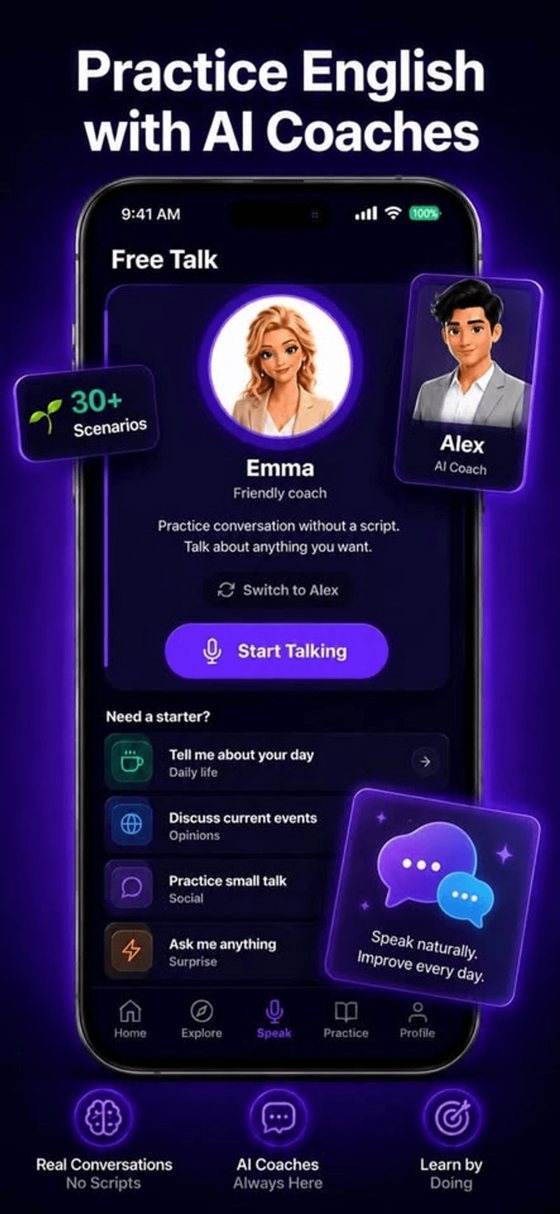
Dans Saloo English, simulez un vrai entretien d'embauche en anglais — présentation, questions pièges, salaire — avec les coachs IA Emma et Alex, et recevez des corrections instantanées sur vos réponses.
 Scannez pour télécharger l'app
Essai gratuit · annulez à tout moment


Questions fréquentes
Comment répondre à « Tell me about yourself » en entretien en anglais ?
En 60 à 90 secondes, en trois temps : présent, passé, futur. Par exemple : « I'm a marketing analyst with three years of experience. In my last role, I grew organic traffic by 40 %. Now I'm looking for a role where I can lead larger projects. » Court, concret, orienté vers le poste.
Comment répondre à « What is your greatest weakness » sans se saboter ?
Choisissez une vraie faiblesse, sans rapport direct avec le cœur du poste, et montrez ce que vous faites pour la corriger. Par exemple : « I used to avoid public speaking, so I volunteered to present our monthly results — it's now a strength. » Ne dites jamais « I'm a perfectionist » sans preuve ni action.
Que répondre à « What are your salary expectations » en anglais ?
Donnez une fourchette basée sur le marché, pas un chiffre sec : « Based on my research and the scope of the role, I'm looking for something in the range of X to Y, but I'm open to discussing the full package. » Cela laisse la négociation ouverte sans vous fermer de porte.