English vocabulary: food and meals — 48 words and expressions
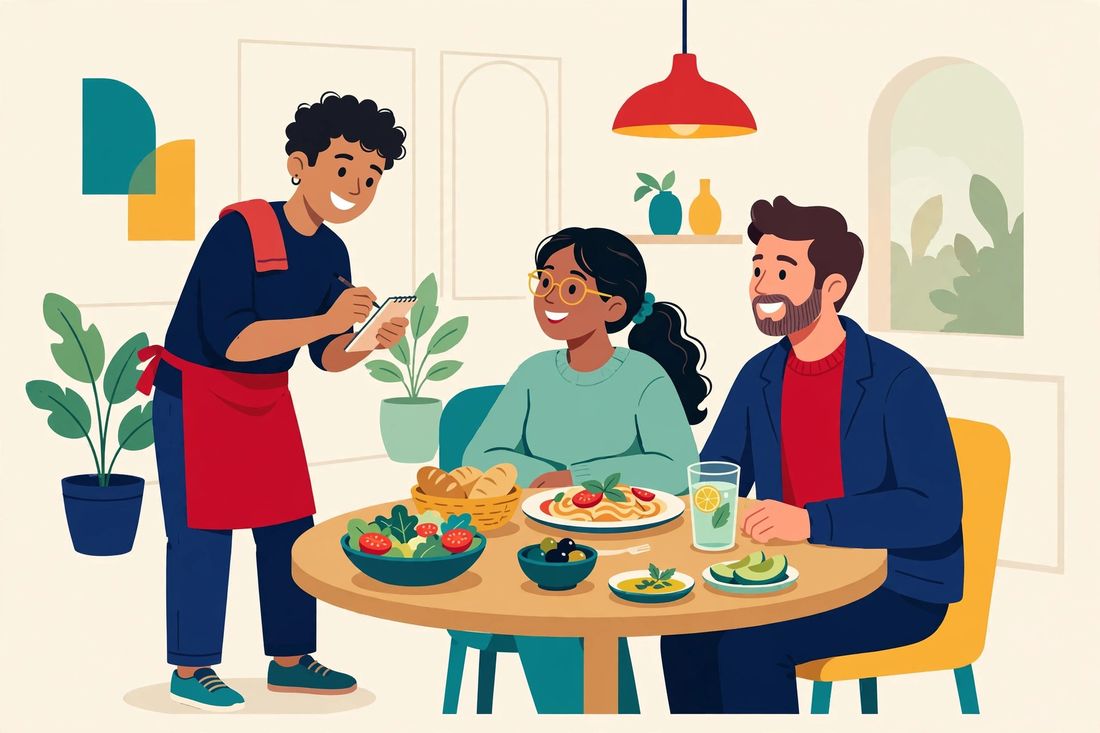
Talking about food is probably the most universal conversation topic in English: ordering at a restaurant, describing a dish, saying what you love and what you can't stand. This page brings together the 48 words and expressions that cover 90% of those situations — meals, everyday foods, tastes, cooking methods and restaurant vocabulary — each with an example sentence the way people really say it. Read them out loud, test yourself with the mini-quiz at the bottom of the page, then use them at your very next meal.
Meals and moments
The English day revolves around three meals — breakfast, lunch and dinner — but meal vocabulary goes further: the starter, the main course, and yesterday's leftovers. These are the foundation words of every conversation about food.
| English | What it means | Example |
|---|---|---|
| breakfast | the first meal of the day | Breakfast is the most important meal of the day. |
| lunch | the midday meal | We have lunch at noon. |
| dinner | the evening meal | Dinner is at seven tonight. |
| snack | a small amount of food between meals | I usually have a snack around four. |
| starter (UK) / appetizer (US) | the first small dish of a meal | I'll have the soup as a starter. |
| main course | the biggest dish of the meal | For the main course, I chose the salmon. |
| side dish | a small extra dish served with the main one | Rice is a common side dish. |
| dessert | the sweet dish at the end of a meal | What's for dessert? |
| dish | food prepared in a particular way | This dish is delicious. |
| meal | breakfast, lunch or dinner | We eat three meals a day. |
| leftovers | food remaining after a meal | We ate the leftovers the next day. |
| recipe | instructions for cooking a dish | This recipe is very easy. |
Everyday foods
The foods you buy, cook and put on the table every day. Learn them in families — dairy, meats, vegetables — rather than alphabetically: that is how your brain will find them again when you need to speak.
| English | What it means | Example |
|---|---|---|
| bread | a basic food made from flour and water | Can you pass me the bread? |
| cheese | a food made from milk | This cheese smells strong. |
| butter | a soft yellow food made from cream | I put butter on my toast. |
| egg | the round food laid by hens | I eat an egg every morning. |
| rice | small white or brown grains eaten cooked | The rice is almost ready. |
| pasta | Italian food made from flour — spaghetti, penne… | We're having pasta tonight. |
| meat | the flesh of animals eaten as food | He doesn't eat meat. |
| chicken | the meat of a chicken; also the bird itself | The chicken is in the oven. |
| fish | an animal that lives in water; also its meat | This fish is very fresh. |
| vegetables | plants eaten cooked or raw — carrots, beans… | Eat your vegetables! |
| fruit | the sweet part of a plant — apples, bananas… | Fruit is a healthy dessert. |
| salad | a mixture of raw vegetables | A green salad, please. |
| soup | a liquid food served hot in a bowl | The soup is too hot. |
| cake | a sweet baked food for celebrations | She baked a chocolate cake. |
Tastes and cooking
Describing a taste and a cooking method is what lets you say whether you like a dish — and order exactly what you want. Watch out for spicy (with a hot, peppery taste) and hot, which can describe a temperature or a spicy taste depending on the context.
| English | What it means | Example |
|---|---|---|
| sweet | with a taste like sugar | This tea is too sweet. |
| salty | with a lot of salt | The soup is a bit salty. |
| sour | with a sharp taste like lemon or vinegar | Lemons are sour. |
| bitter | with a strong, unpleasant taste | Black coffee is bitter. |
| spicy | hot in taste, with chili or strong spices | Careful, this sauce is very spicy. |
| hot | high in temperature; also spicy | The soup is still hot. |
| fresh | recently made or picked, not old | Fresh bread smells wonderful. |
| raw | not cooked | Sushi is made with raw fish. |
| grilled | cooked over direct heat | I love grilled vegetables. |
| fried | cooked in hot oil | Fried eggs are my favourite. |
| baked | cooked in an oven, like bread or cakes | Baked potatoes take an hour. |
| boiled | cooked in boiling water | A boiled egg, please. |
At the restaurant
From the booking to the bill, these are the words that come up at every restaurant meal. If you work with English-speaking customers, our guide to small talk in English will help you keep the conversation going between courses.
| English | What it means | Example |
|---|---|---|
| menu | the list of dishes a restaurant offers | Could we see the menu? |
| waiter / waitress | the person who serves you at the table | The waiter was very friendly. |
| bill (UK) / check (US) | the paper that says what you must pay | Can I have the bill, please? |
| tip | extra money you give for good service | We left a big tip. |
| booking / reservation | a table kept for you in advance | I have a booking for two. |
| still / sparkling water | water without / with bubbles | Sparkling water, please. |
| rare / medium / well done | the three ways to cook a steak | I'd like my steak medium. |
| takeaway (UK) / to go (US) | food you take with you instead of eating there | One coffee to go, please. |
| tasty / delicious | with a very good taste | The meal was delicious. |
| I'm full | the way to say you can't eat any more | No dessert for me, I'm full. |
Expressions to know
Six expressions you will hear in real conversations around the table — none of them translates word for word, and that is exactly why they make a difference.
- I'm starving — literally "I am dying of hunger". The strong, very common version of I'm hungry: Let's eat, I'm starving!
- To grab a bite — to eat something quickly, without a real sit-down meal: Let's grab a bite before the meeting. Perfect for a fast lunch between two appointments.
- Help yourself — the phrase a host uses to invite guests to take food freely, without waiting to be served.
- It's on me — "I am paying the bill". Not to be confused with my treat, which means the same thing with a slightly more celebratory tone.
- To have a sweet tooth — to love desserts and sweet things: She has a sweet tooth, she always orders dessert.
- Seconds — a second portion of a dish. When someone asks Would you like seconds?, they are offering you more food, not a few seconds of waiting.
Common mistakes
- "Entrée" on an American menu: in the United States, entrée means the main course, not the starter. For the first small dish, say starter (UK) or appetizer (US). It is a trap — for portion size and for price.
- A recipe is not a receipt: a recipe tells you how to cook a dish; a receipt is the paper that proves you paid. The two words look alike, are pronounced differently, and get mixed up all the time.
- Grapes are not dried: grapes are the fresh fruit that grows in bunches. Dried grapes are called raisins — a classic mix-up for speakers of French and several other languages, where the word works the other way round.
Progress with Saloo
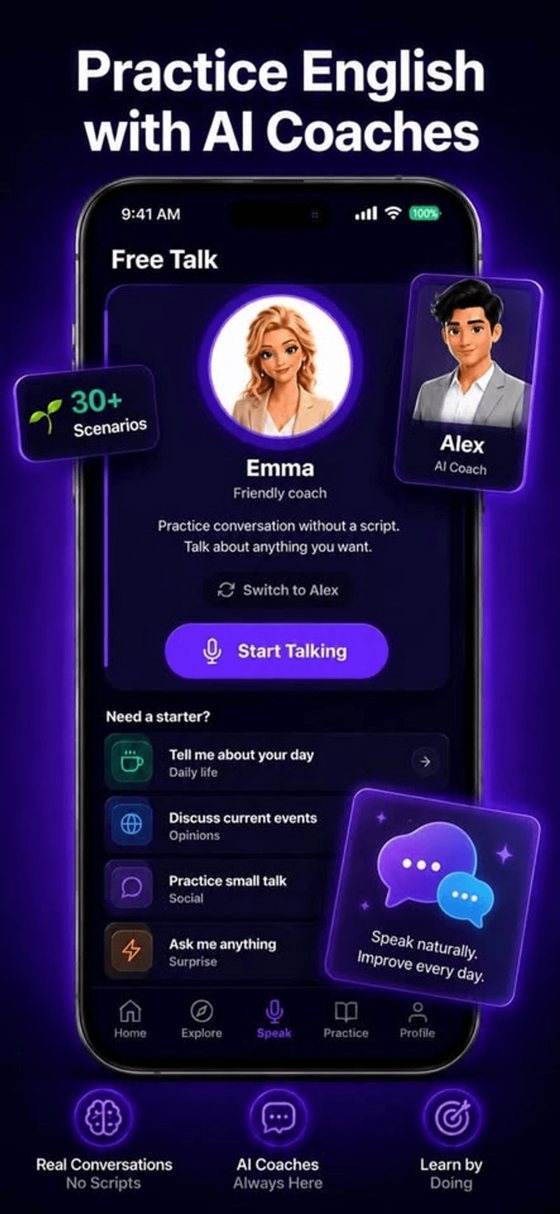
A vocabulary list only helps if it turns into a speaking reflex. In Saloo English, you reuse these words in conversation with Emma and Alex — ordering a meal, talking about your favourite dishes, describing what you ate yesterday — and the AI tutor corrects your pronunciation live. Ten minutes a day is enough to turn these 48 words into sentences that come out on their own. To go further, work on the vocabulary of emotions and feelings too: talking about food and about how you feel covers most everyday conversations.
Want to revise differently? Take the example sentences on this page and practise them with the English shadowing technique, which anchors both the words and their pronunciation by repeating audio out loud.
✦ Download the Saloo app
Learn this vocabulary by speaking it
Voice conversations with an AI tutor, a restaurant scenario and live pronunciation corrections: turn these 48 words into reflexes, 10 minutes a day.
 Scan to download the app


FAQ
How do you say "bon appétit" in English?
There is no word-for-word equivalent. Before a meal, English speakers say "Enjoy your meal!" or simply "Enjoy!". The French phrase "bon appétit" itself is also borrowed in English, especially in restaurants.
What is the difference between "bill" and "check" at a restaurant?
Both mean the piece of paper that tells you what to pay, but "bill" is British and "check" is American. In both countries, the sentence to remember is: "Can I have the bill (or the check), please?"
How do I say how I want my steak cooked in English?
With three words: rare (lightly cooked, red inside), medium (pink inside) and well done (cooked all the way through). For example: "I'd like my steak medium, please." The waiter will often ask: "How would you like your steak?"