Ordering Food in English: Phrases and Typical Dialogues
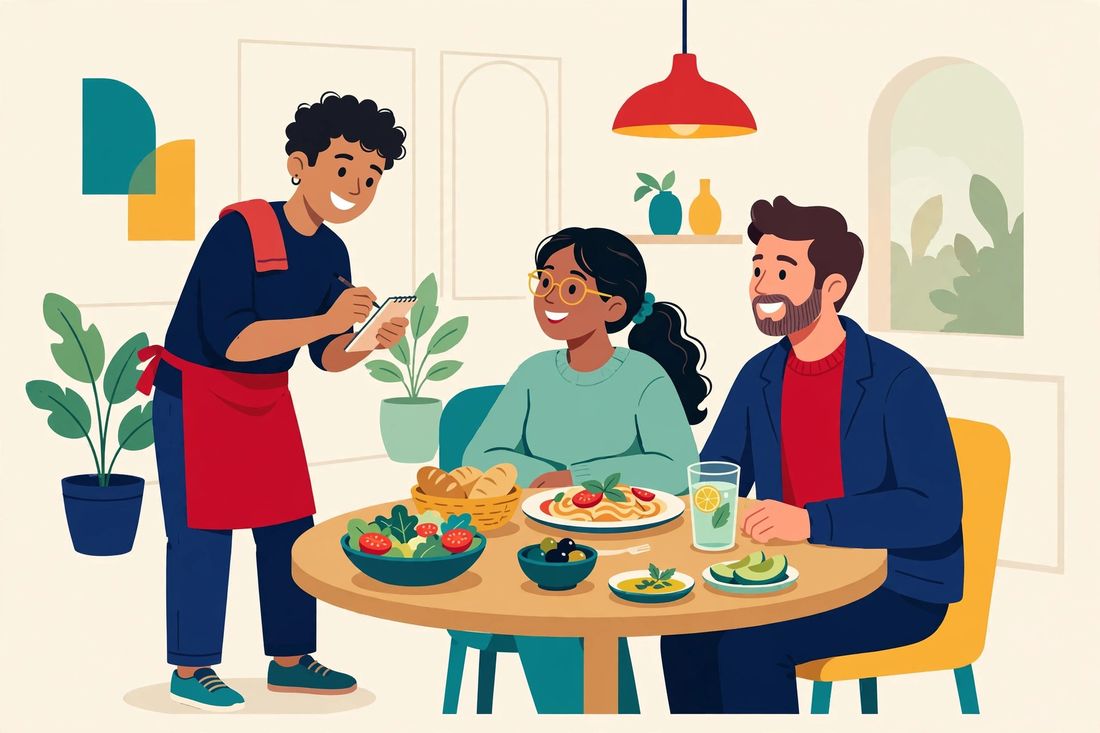
You do not need perfect English to order food — you need a handful of ready-made phrases. In most situations, “I’ll have…” plus the name of the dish is enough, and a few polite extras (“Could I…?”, “Without… please”) will carry you through restaurants, cafés, and delivery orders. Below are the exact phrases, with dialogues you can rehearse out loud before your next meal.
At the restaurant: from the table to the order
It starts before the menu. When you arrive, say: “A table for two, please.” If you booked, add: “We have a reservation under the name Martin.” If the restaurant is full, the host may say: “There’s a 20-minute wait.” You can answer: “That’s fine, we’ll wait.”
Once seated, the waiter usually opens with: “Are you ready to order?” or “Can I get you anything to drink first?” A natural answer is: “Yes, I’ll have a glass of water, please.” To buy time with the menu, say: “Could we have a few more minutes, please?”
When you order, keep the same structure every time: “I’ll have + the dish + please.” For example: “I’ll have the grilled salmon, please.” To order for someone else, use: “She’ll have the salad, and I’ll have the burger.” If you are not sure about a dish, ask: “What do you recommend?” or “Is this dish spicy?”
Typical dialogue — at the table:
- Waiter: “Hi, are you ready to order?”
- You: “Yes. I’ll have the mushroom risotto, please. And a sparkling water.”
- Waiter: “Anything else?”
- You: “No, that’s all, thanks.”
At the café: coffee, pastries, and takeaway
Cafés move fast, so short phrases work best: “A flat white, please,” or “Can I have a latte and a croissant, please?” To specify the size, add it first: “A large cappuccino, please.” For milk: “With oat milk, please,” or “With skimmed milk.”
Two words change everything: “to stay” (you drink it there) and “to go” (takeaway). The barista will often ask: “Is that to stay or to go?” Answer simply: “To go, please.” If you want it less hot, less sweet, or decaf, say: “Not too hot, please,” “No sugar, thanks,” or “Decaf, please.”
Typical dialogue — at the counter:
- Barista: “Hi, what can I get you?”
- You: “A medium latte with oat milk, to go, please.”
- Barista: “Anything to eat?”
- You: “Yes, a chocolate muffin as well, please.”
Delivery and takeaway: ordering by phone or app
Ordering delivery in English follows the same pattern, with a few extra steps. On the phone, start with: “Hi, I’d like to place an order for delivery, please.” Then give your address clearly and slowly, spelling the street name if needed: “It’s 12 Baker Street — B-A-K-E-R.” On an app, you mostly read, but you still need options like “delivery ASAP,” “contactless delivery,” and “leave at the door.”
Useful delivery phrases: “Can I get a large pepperoni pizza and a bottle of water, please?” “Could you add extra napkins, please?” “No onions, please.” If the order is late, call and say: “Hi, I ordered about 40 minutes ago, and it hasn’t arrived yet. Could you check, please?” Keep it polite and factual — you will get help faster than with a complaint.
Special requests and dietary needs
Special requests are where learners freeze, but the formulas are simple. For allergies, be direct: “I’m allergic to peanuts.” For preferences: “No ice, please.” “Dressing on the side, please.” “Well done, please” (for a steak cooked through) or “Medium-rare, please” (pink inside).
To check ingredients, ask: “Does this contain dairy?” “Is this gluten-free?” “Do you have any vegetarian options?” If the answer is unclear, do not guess: “Could you check with the kitchen, please?” is a perfectly normal request. A waiter would rather check than serve you the wrong dish.
Typical dialogue — dietary request:
- You: “Excuse me, is the soup vegetarian?”
- Waiter: “No, it’s made with chicken stock.”
- You: “OK, I’ll have the tomato salad instead, please. No cheese.”
Paying, tipping, and fixing a problem
To ask for the bill, say: “Could we have the bill, please?” In American English, “check” is more common: “Could we have the check, please?” If you pay separately, say it before the waiter leaves: “Separate bills, please.” To pay by card: “Can I pay by card?”
Tipping rules vary: in the US, 15–20% is standard; in the UK, check if service is included (“Is service included?”); elsewhere, rounding up is often enough. If something is wrong, stay calm and specific: “Excuse me, I ordered the fish without sauce, but this one has sauce.” Then: “Could you change it, please?” A clear description solves the problem; a vague “This is wrong” does not.
Mistakes to avoid when ordering
- Saying “I want…” to a waiter. It sounds demanding. “I’ll have…” or “Can I have…?” is polite and just as simple.
- Forgetting “please” and “thanks.” They cost nothing and change the whole tone of the exchange.
- Pointing silently at the menu. Even a short phrase (“This one, please”) keeps you in the conversation — and trains your spoken English.
- Panicking when you do not understand. Say: “Sorry, could you repeat that, please?” or “Could you speak a bit more slowly, please?” Staff hear this every day.
Ordering food is one of the best speaking workouts there is: short, repeated, and immediately useful. Rehearse one dialogue from this guide out loud, then use it for real at your next restaurant or café. To warm up, try our 30 small talk examples, and to stop translating every phrase in your head, practise how to think in English — then finish with our 15-minute shadowing routine.
✦ Download the Saloo app
Order in English without freezing
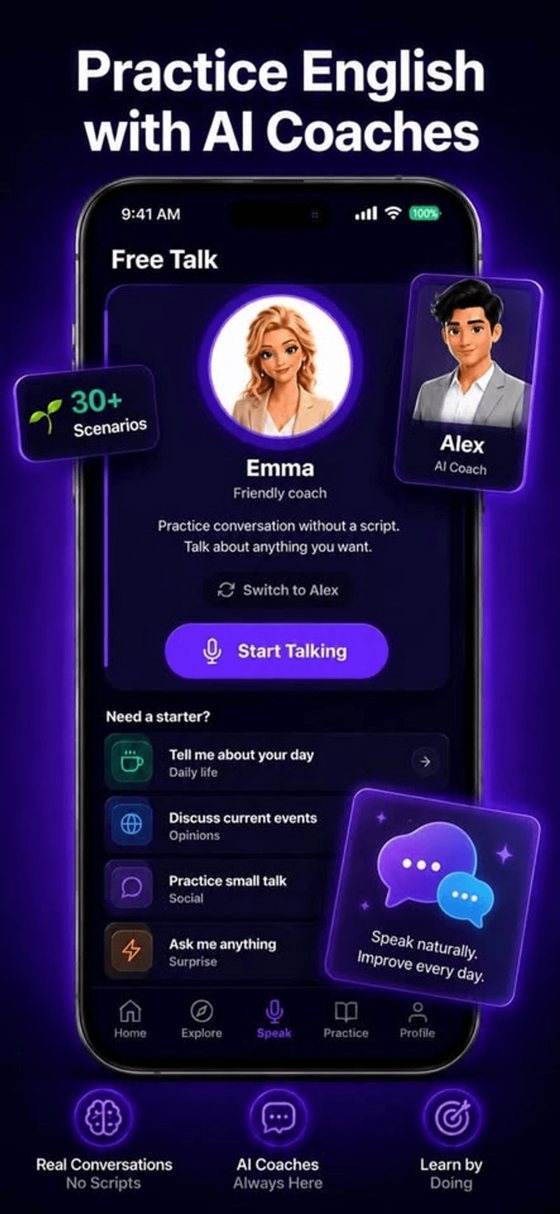
In Saloo English, practise restaurant, café, and delivery dialogues with the AI coaches Emma and Alex: real exchanges, instant corrections, and the confidence to order for real — no more silent pointing at the menu.
 Scan to download the app
Free trial · cancel anytime


FAQ
What is the simplest way to order food in English?
Say “I’ll have…” followed by the dish, for example “I’ll have the chicken pasta, please.” It is polite, natural, and works in restaurants, cafés, and fast-food places.
How do I ask for something without meat, gluten, or dairy in English?
Use “Does this contain…?” or “Do you have anything without…?” For example: “Does this contain nuts?” or “Do you have any gluten-free options?” Always mention an allergy clearly: “I’m allergic to peanuts.”
How do I ask for the bill or complain politely in English?
Ask for the bill with “Could we have the bill, please?” If something is wrong, stay calm and specific: “Excuse me, I ordered the soup without cream, but this one has cream.” Staff can only fix what you describe clearly.