Job Interview in English: 20 Common Questions and Sample Answers

An English job interview is not a test of perfect English — it's a test of clear, structured answers. Recruiters ask the same 20 questions almost everywhere. Below: the 20 questions, a framework for each, and a short sample answer you can adapt — with the 60-second rule for every answer.
The 60-second rule for every answer
Whatever the question: one clear idea, one concrete example, one result, in about 60 seconds. Practice out loud with a timer — silent reading doesn't train your mouth. A good filler for thinking time: "That's a great question — let me think for a second."
Openers: questions 1–4
The first minutes set the tone: short, positive, never criticize a previous employer. Warm up with a few minutes of small talk in English first.
1. "Tell me about yourself." — Present, past, future in 60 seconds. "I'm a backend developer with four years of experience at a logistics startup. Before that I worked in support, which taught me to understand users. Now I want to join a larger product team and keep growing."
2. "Walk me through your résumé." — Pick the 3 experiences most relevant to this job and connect them. "I started in… then moved to… which led me to…"
3. "Why are you leaving your current job?" — Forward-looking, never bitter. "I've learned a lot there, and now I want new challenges — especially in [skill the new job offers]."
4. "What do you know about our company?" — One fact about the company, one about the product, one reason it interests you. "I know you launched [product] last year and are expanding into [market]. What interests me is…"
Motivation and company fit: questions 5–8
Here the recruiter checks that you want this job, not just any job. Be specific — vague enthusiasm convinces nobody.
5. "Why do you want this job?" — Connect the role to your skills and direction. "This role combines [skill A] and [skill B], exactly where I've been growing — and your focus on [X] matches what I want to do next."
6. "Why should we hire you?" — Your pitch: 2 strengths, 1 proof each. "I bring [strength 1] — for example, I [result]. And [strength 2]: I [result]."
7. "What makes you a good fit?" — Mirror the job description: pick 2–3 requirements and show you meet them. "You need someone who can [requirement] — in my last role I [example]."
8. "Where do you see yourself in five years?" — Ambition that fits the company. "In five years I see myself as a senior [role], mentoring others and owning bigger projects — ideally here."
Strengths, weaknesses and the tricky ones: questions 9–12
These test honesty and self-awareness. Never say "I have no weaknesses" — and never disguise a strength as a weakness.
9. "What are your greatest strengths?" — Name 2, each with proof. "I'm organized — I kept our sprint board clean and we shipped on time for six months. And I explain technical things simply, which helped onboard three juniors."
10. "What is your biggest weakness?" — A real weakness + what you're doing about it. "I used to avoid public speaking. Last year I started presenting our sprint reviews — still uncomfortable, but I'm improving."
11. "What is your greatest achievement?" — One story, with a number. "[Project]: the situation was [X], I did [Y], and the result was [Z — a number]."
12. "What are your salary expectations?" — A researched range, not a single number. "For this role in this market, I'm looking at [X] to [Y], but I'm open to discussing the full package."
Behavioral questions and the STAR method: questions 13–17
Questions starting with "Tell me about a time…" want stories built with STAR: Situation, Task, Action (what you did — say "I", not "we"), Result.
13. "Tell me about a challenge at work." — Our main client threatened to leave. I called them, found the real problem — slow support — and set up a weekly check-in. Result: they renewed for two years.
14. "Describe a time you worked under pressure." — Show calm and method. 48 hours to fix a production bug before launch. I split the problem into parts, assigned each to one person, and we shipped with six hours to spare.
15. "Tell me about a conflict with a colleague." — Show you resolve, not escalate. We disagreed on the technical approach, so we each prototyped for one day and compared — his was better, and I said so.
16. "Give an example of a mistake you made." — Own it, show the lesson. I once deployed without running the full tests and broke the checkout page for an hour. I never skip the checklist now — and I added it to our team process.
17. "Tell me about a time you showed leadership." — Leadership isn't a title. When our lead was on leave, I ran stand-ups and unblocked two tickets by pairing with the juniors — the sprint finished on time.
Your turn — questions to ask the recruiter: 18–20
Always ask 2–3 questions — "no questions" signals zero interest. Ask about the role and the team, never salary or vacation in the first round.
18. "What does a typical day look like in this role?" — Shows you picture yourself in the job.
19. "What are the biggest challenges the team is facing?" — Shows you want to solve problems, not just collect a paycheck.
20. "What are the next steps in the hiring process?" — Always end here: it shows you're serious.
The 3 mistakes that cost non-native speakers the job
Mistake 1: translating in your head. It produces slow, tangled sentences. Practice answering out loud until structures come directly — try the 15-minute shadowing routine.
Mistake 2: apologizing for your English. "Sorry for my bad English" frames everything negatively. Say instead: "English is my second language — stop me if anything is unclear."
Mistake 3: giving yes/no answers. One-word answers kill interviews — add a STAR story: "Yes — for example, in my last role…" Not sure where your English stands? Take the English level test first.
✦ Download the Saloo app
Rehearse your interview with coaches that never get tired
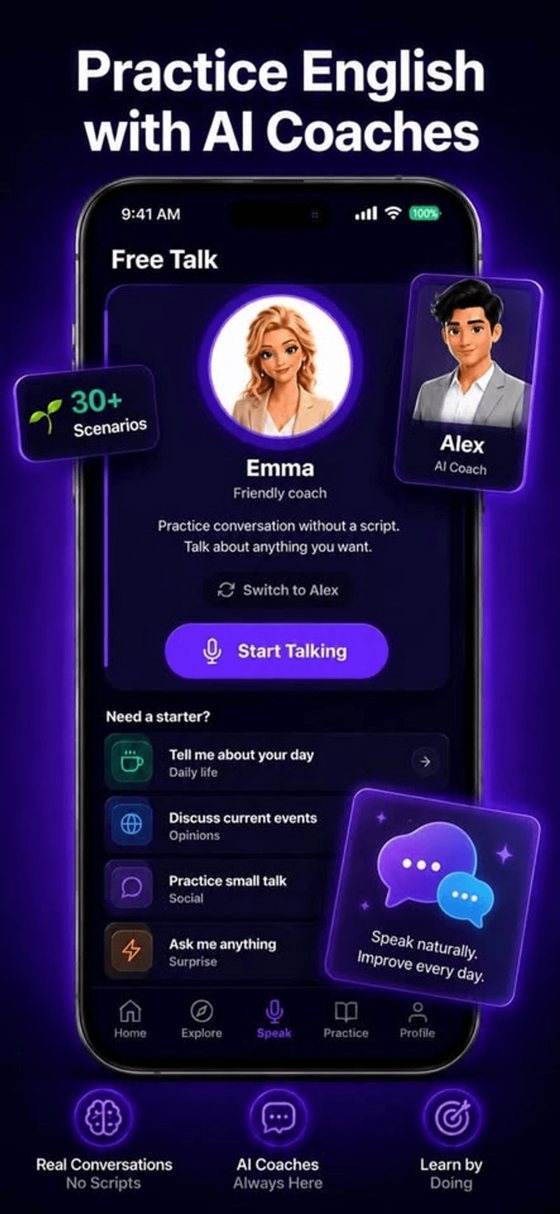
Saloo English lets you rehearse job interviews out loud with Emma and Alex — realistic questions and instant corrections on your English.
 Scan to download the app


FAQ
How long should my answers be in an English job interview?
Aim for about 60 seconds per answer: one clear idea, one concrete example, one result. Longer than two minutes loses the recruiter's attention; shorter than 20 seconds sounds evasive.
What should I do if I don't understand a question during the interview?
Ask for clarification confidently: "Could you rephrase that, please?" Recruiters respect this far more than a confused guess, and it buys you thinking time.
Should I memorize my answers word for word?
No — memorized answers sound robotic and collapse if the question is rephrased. Learn frameworks instead (STAR for stories, the 60-second structure for the rest) and practice saying them out loud.