How to Practice English Speaking Alone: The Complete 2026 Guide

Yes, you can get much better at speaking English entirely on your own. The winning formula is 20 minutes a day: warm up your mouth, shadow a native speaker, talk freely for a few minutes, then listen back and fix one thing. No partner, no class, no embarrassment — just a daily routine your mouth and brain can rely on. Here is the complete method, with the techniques, a sample week, and the traps to avoid.
Why practicing alone actually works
Most learners wait for a conversation partner before they start speaking — and so they almost never speak. That is backwards. Speaking is first a physical skill: your tongue has to learn new positions, your ears have to recognize fast sounds, and your brain has to retrieve words under time pressure. All three improve through solo repetition, long before anyone listens to you.
Solo practice has three advantages: you control the difficulty, you can repeat one sentence ten times without boring anyone, and you can record yourself and hear exactly what needs fixing. The only thing it cannot fully replace is surprise — a real person asks unprepared questions. Section 3 shows how to simulate that with role-play and timed answers.
The 20-minute daily routine
Do this five or six days a week, ideally at the same time. Set a timer and keep it short: a routine you actually do beats a perfect one you skip.
- Minutes 0–3: warm up. Read a short paragraph aloud, slowly, exaggerating the sounds. Focus on one sound per week: the th in “think”, the English r, or “ship” vs “sheep”.
- Minutes 3–10: shadow. Play 60 seconds of a podcast, a series scene, or an app dialogue, and repeat it a half-second behind the speaker, copying rhythm and intonation. Repeat the same minute three times. Our 15-minute shadowing routine explains the steps.
- Minutes 10–17: talk freely. Pick one prompt — “What did I do yesterday?”, “Describe my morning” — and speak for two minutes without stopping. No notes, no dictionary. If a word is missing, describe it instead of freezing.
- Minutes 17–20: listen and fix one thing. Record the free-talk part, listen once, and note a single correction: one mispronounced word, one repeated “uh”, one sentence to rebuild. One fix per day compounds fast.
That is the whole system. Everything else here is a variation on these four blocks.
7 solo techniques that build real fluency
1. Self-talk narration. Narrate what you are doing, out loud or silently: “I am making coffee. I need milk — none left, I will buy some later.” Daily life is where 80% of real conversation happens. Combine this with thinking directly in English and the translation pause disappears.
2. Shadowing. The single best pronunciation exercise: copy a native speaker in real time. Start with slow, clear audio, then move to series dialogue. Two minutes a day changes your accent faster than an hour of silent reading.
3. Record and compare. Read one sentence, record it, then play the original and your version back to back. You will hear the gap instantly — flat intonation, a swallowed ending, a vowel too long. Re-record until they sound close.
4. Role-play both sides. Play customer and waiter, interviewer and candidate, tourist and receptionist. A two-minute role-play — “Hi, I would like a table for two, please.” — rehearses exactly the sentences you will need. Start with our 30 small talk examples as scripts.
5. Timed answers. Give yourself a question and 30 seconds to answer out loud: “What is your dream job and why?” The timer forces you to start before the sentence is perfect — the exact skill real conversation demands. Start with three sentences, then five.
6. Describe a picture. Open any photo and describe it for one minute: who is there, what they are doing, what might happen next. This trains everyday-scene vocabulary instead of only memorized sentences.
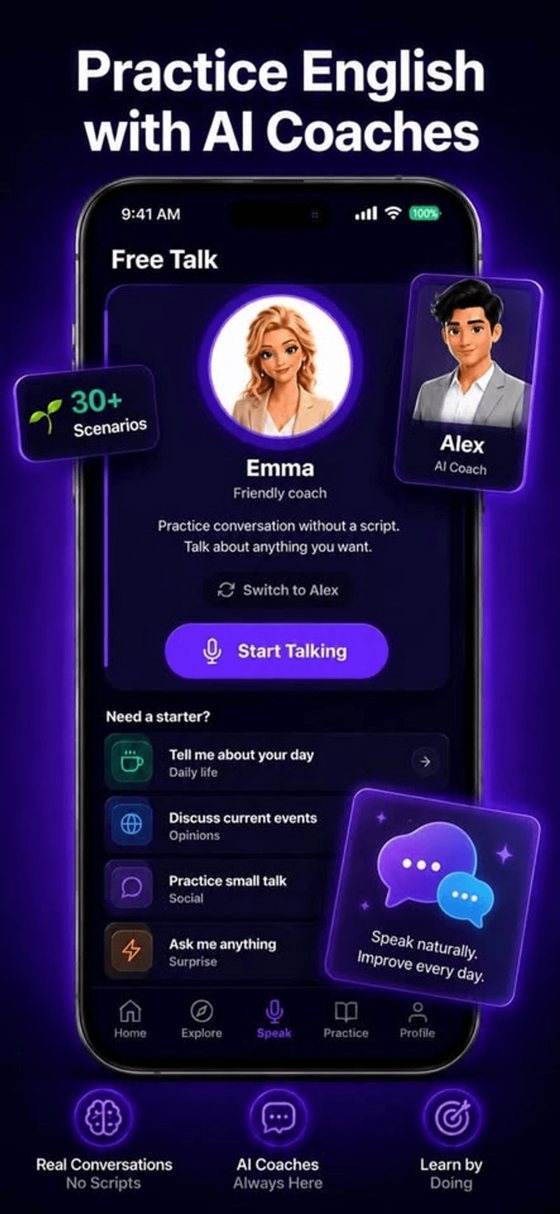
7. Talk to an AI coach. When you want a reaction — a follow-up question, a correction, a new topic — an AI partner fills the gap a human would leave. You speak, it answers, you answer back: the closest thing to a real exchange, available at midnight, without judgment.
A sample week you can copy
Keep the 20-minute skeleton, but rotate the focus:
- Monday — pronunciation: warm-up on one sound, shadow a news clip, free-talk about your weekend.
- Tuesday — everyday life: self-talk narration all day in short bursts, plus one recorded role-play (ordering coffee).
- Wednesday — storytelling: describe your day in the past tense for two minutes, then retell it with more detail.
- Thursday — opinions: timed answers on one debate topic: “Is remote work better than office work?” Argue both sides.
- Friday — real-life scripts: rehearse a situation you will actually face soon: a meeting, a trip, a phone call.
- Saturday — review: listen to Monday's and Friday's recordings. Notice what improved. Pick next week's single sound to work on.
- Sunday — rest, or a light 10 minutes of shadowing a series scene you enjoy. Rest is part of the method, not a failure.
After four weeks, most learners notice the same shift: sentences start coming out before they are fully planned. That is fluency beginning — not perfection, but momentum.
The 4 mistakes that waste solo practice
- Only reading silently. Reading builds vocabulary, not speaking. If your mouth never moves, your speaking does not improve — no matter how many pages you read.
- Practicing once a week for two hours. Marathon sessions exhaust you and fade fast. Twenty minutes daily wins every time.
- Stopping at every unknown word. Freezing to look up a word trains hesitation, not fluency. Describe it, move on, look it up afterwards.
- Never listening back. Without recording, you practice your mistakes as confidently as your correct sentences. One listen-back per session is the cheapest correction you will ever get.
✦ Download the Saloo app
Practice speaking every day with an AI coach
In Saloo English, converse with the AI coaches Emma and Alex: real exchanges, instant corrections, new topics whenever you want — the perfect partner for your daily 20 minutes.
 Scan to download the app
Free trial · cancel anytime


FAQ
Can you really improve your spoken English alone, without a partner?
Yes. Speaking is a motor skill: mouth, ears and reflexes improve through repetition, even solo. Shadowing, self-talk, recording and AI conversation build fluency; a partner mainly adds spontaneity, which role-play and timed answers simulate.
How much time per day is enough to practice speaking alone?
Twenty minutes a day, five to six days a week, beats two hours once a week. Short daily sessions keep your mouth used to English sounds and your reflexes fast. Consistency matters far more than session length.
What is the best first exercise if I feel shy speaking alone?
Start with shadowing: repeat a short audio a half-second behind the speaker, so you are never inventing sentences. It feels less exposed than free talking, and after a week your mouth is already more comfortable producing English sounds.