English for developers: essential phrases and vocabulary
Code is universal, but the job is not: stand-ups, code reviews, pull requests and debugging all happen in English on international teams. The good news is that the job's vocabulary is small and very repetitive. This page gathers the 22 terms you hear every week, the phrases to report your work, ask for a review and flag a problem — plus a full mini-dialogue to repeat out loud.
Essential vocabulary
The 22 terms that run an English-speaking team's daily life — each with an example sentence, the way it is actually used.
| English | Meaning | Example |
|---|---|---|
| stand-up | a short daily team meeting | We have a stand-up at nine thirty. |
| sprint | one focused work period | We plan the sprint every two weeks. |
| backlog | tasks not done yet | This ticket is at the top of the backlog. |
| pull request (PR) | a proposal to add your code | I opened a pull request this morning. |
| code review | teammates checking your code before merging | My code is waiting for a review. |
| merge | combining code into the main branch | Can we merge this branch now? |
| bug | an error in the code | We found a bug in the login page. |
| debug | to find and fix code errors | I'll debug this after lunch. |
| deployment | putting new code live | The deployment is scheduled for Friday. |
| rollback | returning to the previous working version | We did a rollback after the crash. |
| feature | a new product function | We're building a dark mode feature. |
| hotfix | an urgent small fix | This is a hotfix, it goes out today. |
| legacy code | working old code that is hard to change | That module is legacy code from 2015. |
| technical debt | quick fixes that cost time later | We took on technical debt to ship faster. |
| blocker | something that stops your work | The broken test suite is my blocker. |
| stakeholder | someone with a stake in the result | We need the stakeholders' approval. |
| estimate | a guess about work duration | My estimate is three days. |
| scope | the limits of what a task includes | That request is out of scope. |
| trade-off | a choice between two imperfect options | It's a trade-off between speed and quality. |
| edge case | a rare case the code must handle | We missed an edge case with empty names. |
| bandwidth | time or capacity for more work | I don't have the bandwidth for another ticket. |
| onboarding | helping a new person start well | Your onboarding starts on Monday. |
Key phrases
The daily stand-up
- Yesterday I worked on… — report what you finished.
- Today I'm going to… — say today's plan.
- I'm blocked on… — name your blocker.
- I need help with… — ask for help directly.
Code reviews and pull requests
- Could you review my PR when you have a moment? — ask for a review politely.
- I left a few comments on your PR. — say you reviewed the code.
- This LGTM — let's merge it. — “looks good to me”: approve it.
- Can you add a test for this edge case? — request a change politely.
Working with the team
- Can we jump on a quick call? — ask for a short call.
- Let's take this offline. — continue this later, outside the meeting.
- Could you walk me through this part? — ask for a step-by-step explanation.
- The deployment is on hold until the tests pass. — explain a delay in one clear sentence.
Sample dialogue: a stand-up and a code review
Maya (tech lead): Let's start the stand-up. Leo, what are you working on? (opens the meeting, asks Leo to report)
Leo: Yesterday I finished the login fix. Today I'm going to refactor the payment module. (reports yesterday, plans today)
Maya: Any blockers? (asks about blockers)
Leo: I'm blocked on the staging server — it's down since this morning. (he names his blocker clearly)
Maya: I'll take this offline with DevOps after stand-up. Can you review my PR in the meantime? (assigns a fix, asks for a review)
Leo: Sure. One question — this function looks good, but can you add a test for the empty cart edge case? (politely requests a test)
Maya: Good catch. I'll push the test, then we can merge. (accepts the feedback — the PR moves forward)
Common mistakes of non-native speakers
- “I am agree”: English says I agree — the verb needs no helper: I agree with this approach.
- Using “actual” for “current”: actual means “real”, not “current”. Say current or latest: the latest version of the code.
- “I'm interesting in”: the correct form is interested in — I'm interested in this ticket. “Interesting” describes something else.
- “Do you can review this?”: modal verbs don't combine. Ask Can you review this? — no “do” before “can”.
Grow with Saloo
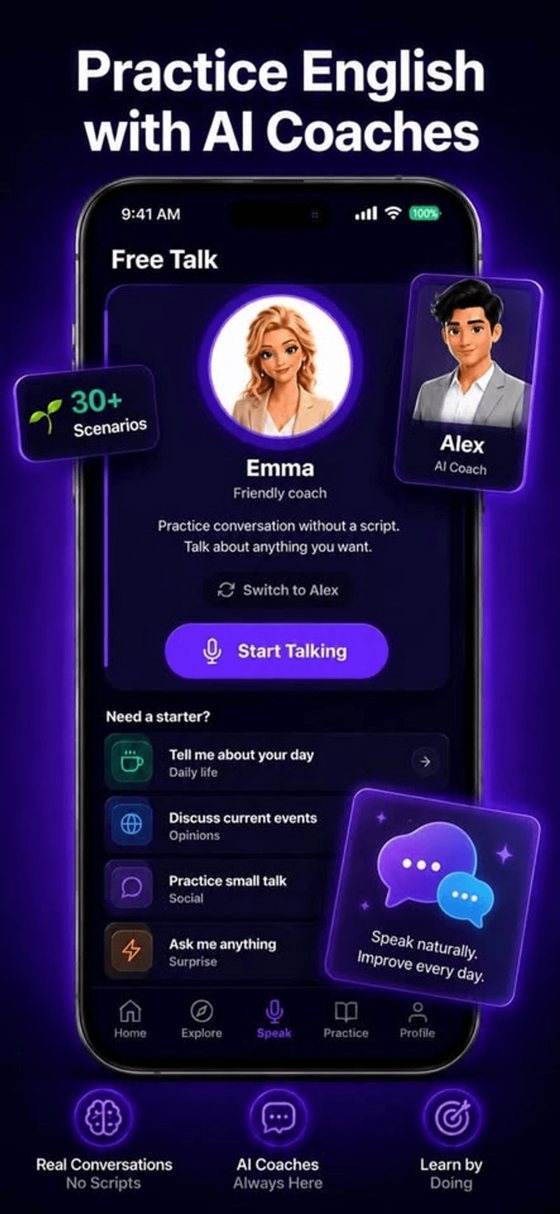
Knowing these phrases is not enough: in a stand-up or a code review, they must come out automatically, with the right pronunciation. In Saloo English, you repeat them with our shadowing technique, then practice with Emma and Alex on team scenarios — stand-ups, code reviews, unblocking a teammate. That repetition in context makes them automatic when it counts. And for the human side of the job, small talk keeps team chat natural, while hotel phrases cover your business trips.
✦ Download the Saloo app
Practice like it's the real thing
Voice conversations with an AI tutor, stand-up and code review role-plays, instant pronunciation feedback: speak up in English with your international team, 10 minutes a day.
 Scan to download the app


Frequently asked questions
What is a stand-up in English?
A short daily team meeting where each developer says what they did yesterday, what they will do today, and what is blocking them. In English-speaking teams it is usually called the “daily stand-up”.
What does LGTM mean?
LGTM means “Looks good to me”. In a code review it signals that the reviewer approves the pull request and it can be merged.
Do I need perfect English to work with an international development team?
No. Clear, simple phrases beat complex grammar: what matters is precision — naming the blocker, describing the bug, asking for a review. Clarity matters far more than perfect grammar.